How we led the architecture of a national health information system, and built its health ID, birth declaration, equipment management and citizen platforms, alongside EY within a UNOPS program

Tunisian Ministry of Health: Building the Foundations of a National Digital Health System

Tunisian Ministry of Health: Building the Foundations of a National Digital Health System
Tunisian Ministry of Health

Tunisian Ministry of Health

The Tunisian Ministry of Health is modernizing its health information system through a national program financed by the World Bank and implemented by UNOPS, with EY Tunisia as program lead.

Highlights

  • Lead technical architecture of a national health information system
  • National Health ID registry with 3.3 million entries
  • 5 platforms, from the maternity to the citizen app
  • With EY Tunisia, within a UNOPS program financed by the World Bank

Services

  • Digital Transformation Advisory
  • Industry-Specific Consulting
  • End-to-End Project Delivery
  • Systems & Product Integration
  • Data Architecture & Infrastructure
  • Data Security & Compliance

Industry

  • Government

3.3M

entries in the National Health ID registry

5

national platforms designed, built or aligned by Satoripop

80

health professionals trained on the birth declaration and enrolment platforms

18

Satoripop experts mobilized on the program

About the program

A national program to modernize the health information system of Tunisia, financed by the World Bank and implemented by UNOPS.

The Ministry of HealthOwner of the program, with its IT centre hosting and operating every platform.
EY TunisiaProgram lead, steering the workstreams: urbanization, health ID, school health and equipment.
SatoripopSenior technical architect of the whole program, and builder of five of its platforms.

The Challenge

Many health applications, no shared identity of the patient

Fragmented systems

Hospital systems, vaccination, school health, equipment and HR were each built separately, by different vendors, with their own data and their own logins.

No national patient identifier

Without a unique health identifier, the same citizen exists several times across facilities, and records cannot follow them from birth to adulthood.

Many stakeholders

The ministry, its IT centre, the national registry, international funders, a Big Four program lead and several software vendors all had to move in the same direction.

Sovereign and secure by design

Health data must stay in Tunisia, hosted by the ministry, with high availability, security testing and transfer of skills to the ministry's own teams.

Our approach:

one identity, one architecture, many services

  • Urbanize first: a target architecture every vendor aligns with

  • Put a national health ID at the centre, shared through secured APIs

  • One single sign-on for citizens and health professionals

  • Transfer the skills, so the ministry runs its own platforms

One National Health Identity

Five platforms built around the same identifier
Lead architecture

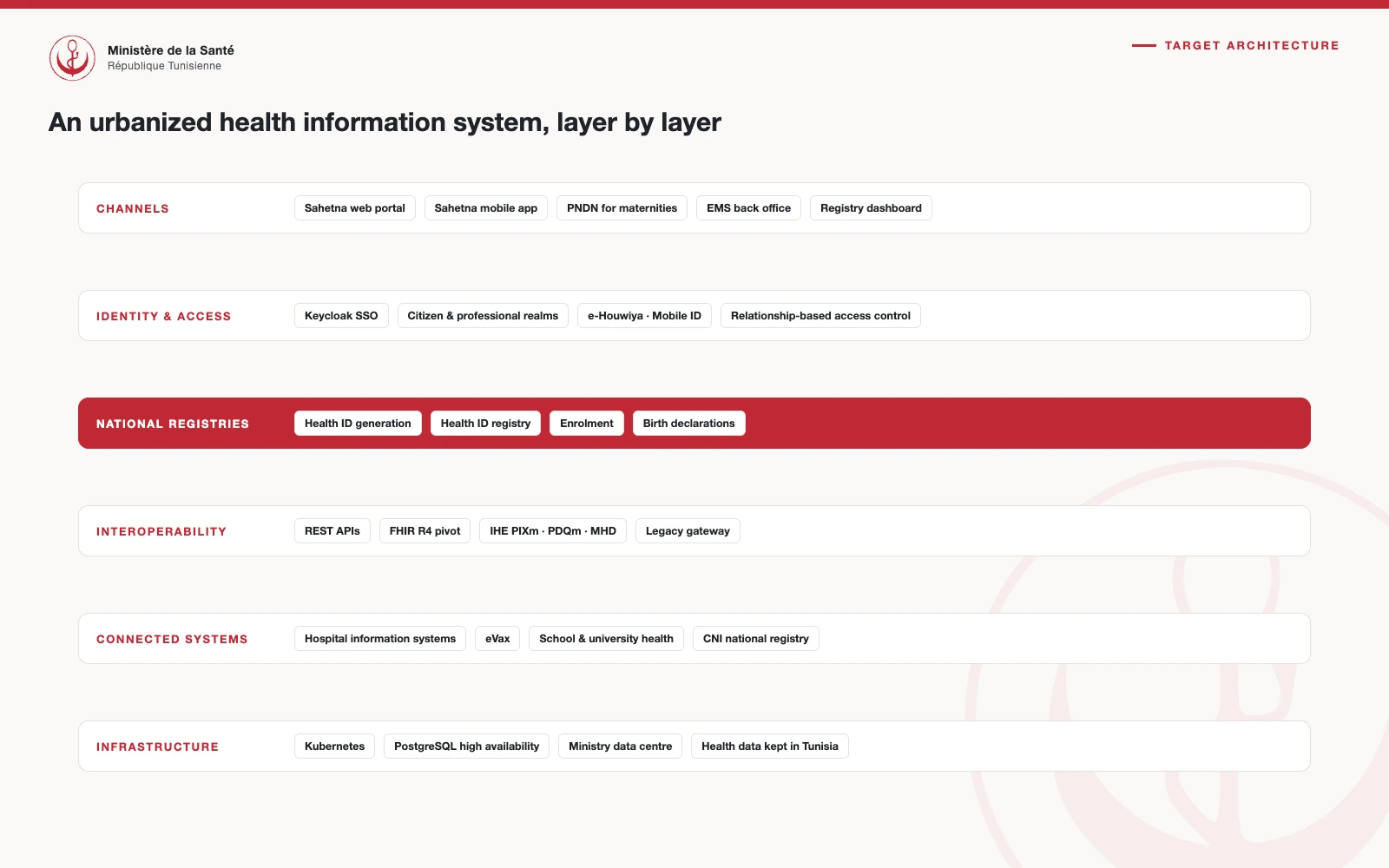
Urbanization of the health IS

The target architecture every platform of the ministry now aligns with.

  • Architecture committees with the ministry and every vendor
  • Architecture documents validated by the ministry
  • FHIR R4 and IHE interoperability strategy
  • Training of the ministry's technical teams
In production

National Health ID & SSO

A unique health identifier for every citizen, and one login for citizens and health professionals.

  • ID generation aligned with the national registry
  • Health ID registry, with 3.3 million entries
  • Secured APIs for hospitals and health apps
  • Single sign-on, enrolment and registry dashboard
Maternities

PNDN: national birth declaration

Health professionals declare every newborn from the maternity, who receives a health ID from birth.

  • Declaration with parents' data pre-filled
  • Printable summary and multilingual interface
  • 80 health professionals trained on the platform
In production

EMS: equipment management

Medical equipment and its maintenance, managed across health facilities.

  • Inventories, work requests, losses and retirement
  • Maintenance contracts, preventive and corrective maintenance
  • Data migrated for the pilot facilities
Mobile app in acceptance testing

Sahetna: the citizen app

The citizen showcase of the national health ID, on the web and as a mobile app.

  • Sign-in with the national digital identity
  • Children, vaccination, school and university health
  • Declared medical record, health near me, complaints
Connected

Hospitals & national services

The platforms plug into the systems that already exist.

  • Hospital information systems, patient indexes unified on the health ID
  • National vaccination system and school health
  • National registry and digital identity provider
A health ID from the very first day

A health ID from the very first day

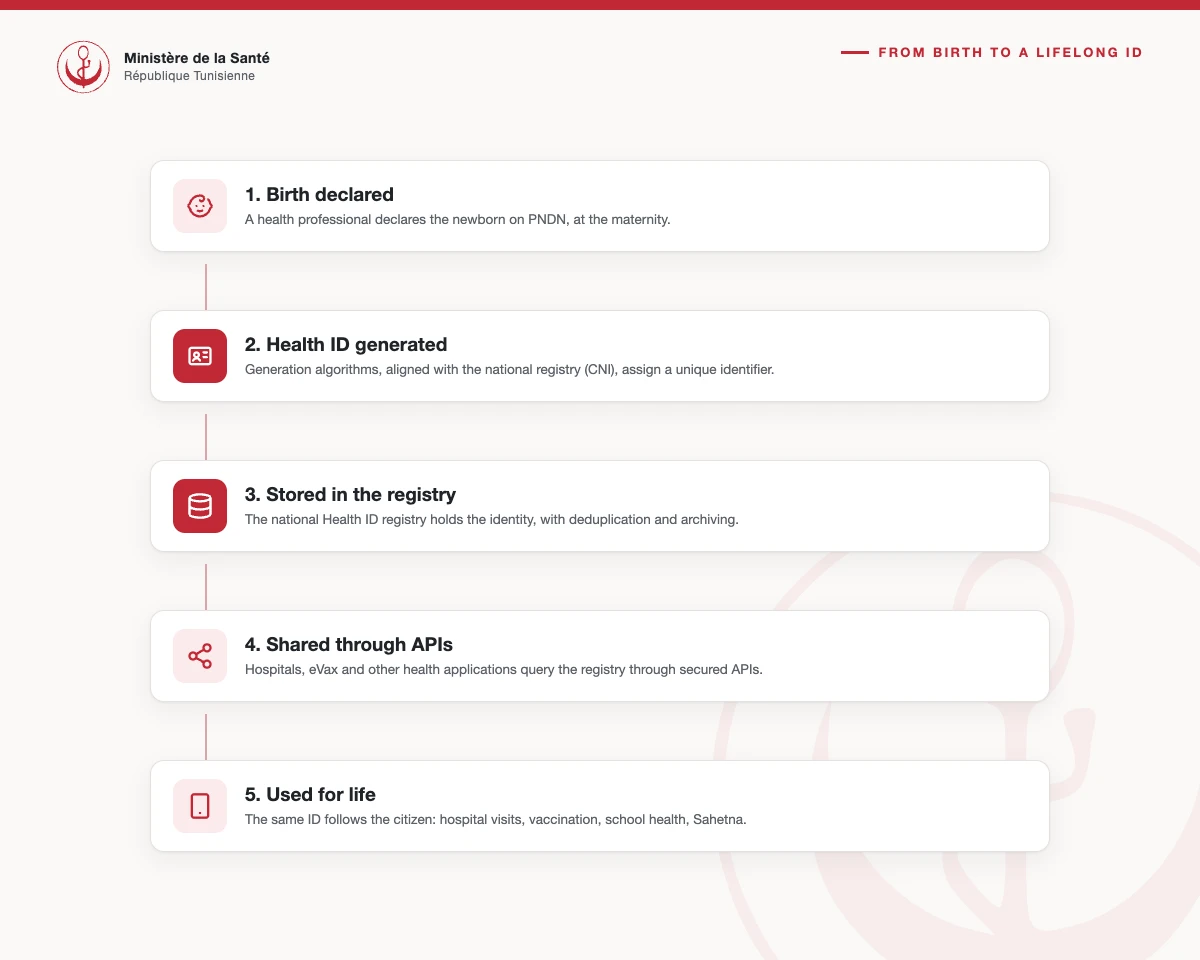
The National Health ID is generated in line with the national registry and stored in a central registry. Every health application, from the maternity to the hospital, queries it through secured APIs.

  • Generation algorithms validated by the ministry
  • Registry with deduplication, validation and archiving
  • Access partitioned by facility with relationship-based access control
  • Single sign-on for citizens and health professionals, in production
Every medical device, followed

Every medical device, followed

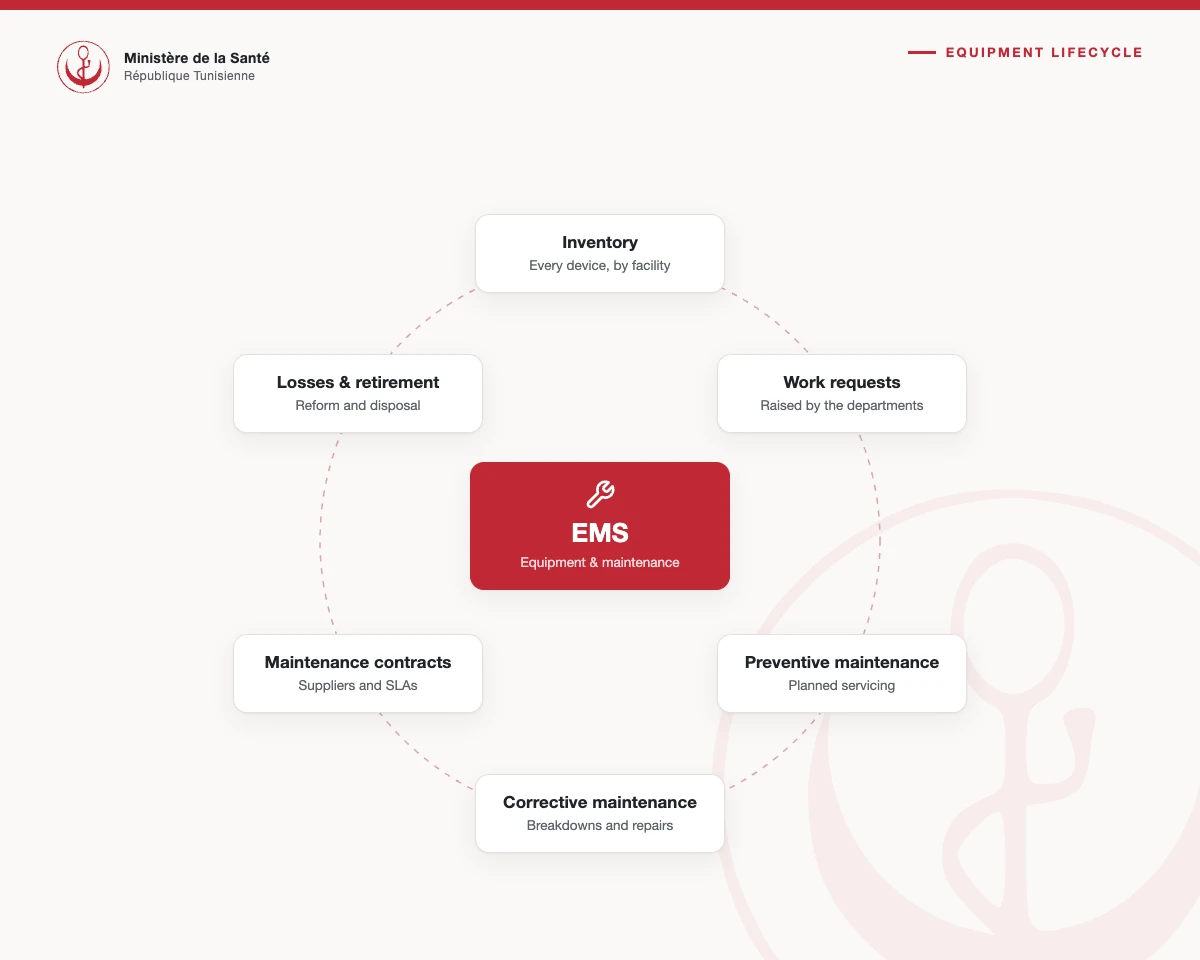
EMS gives health facilities one tool to manage their equipment and its maintenance, from inventory to retirement.

  • Inventories and work requests by facility
  • Maintenance contracts, preventive and corrective maintenance
  • Interfacing studied with hospital systems and the cold chain
Sahetna, the citizen showcase

Sahetna, the citizen showcase

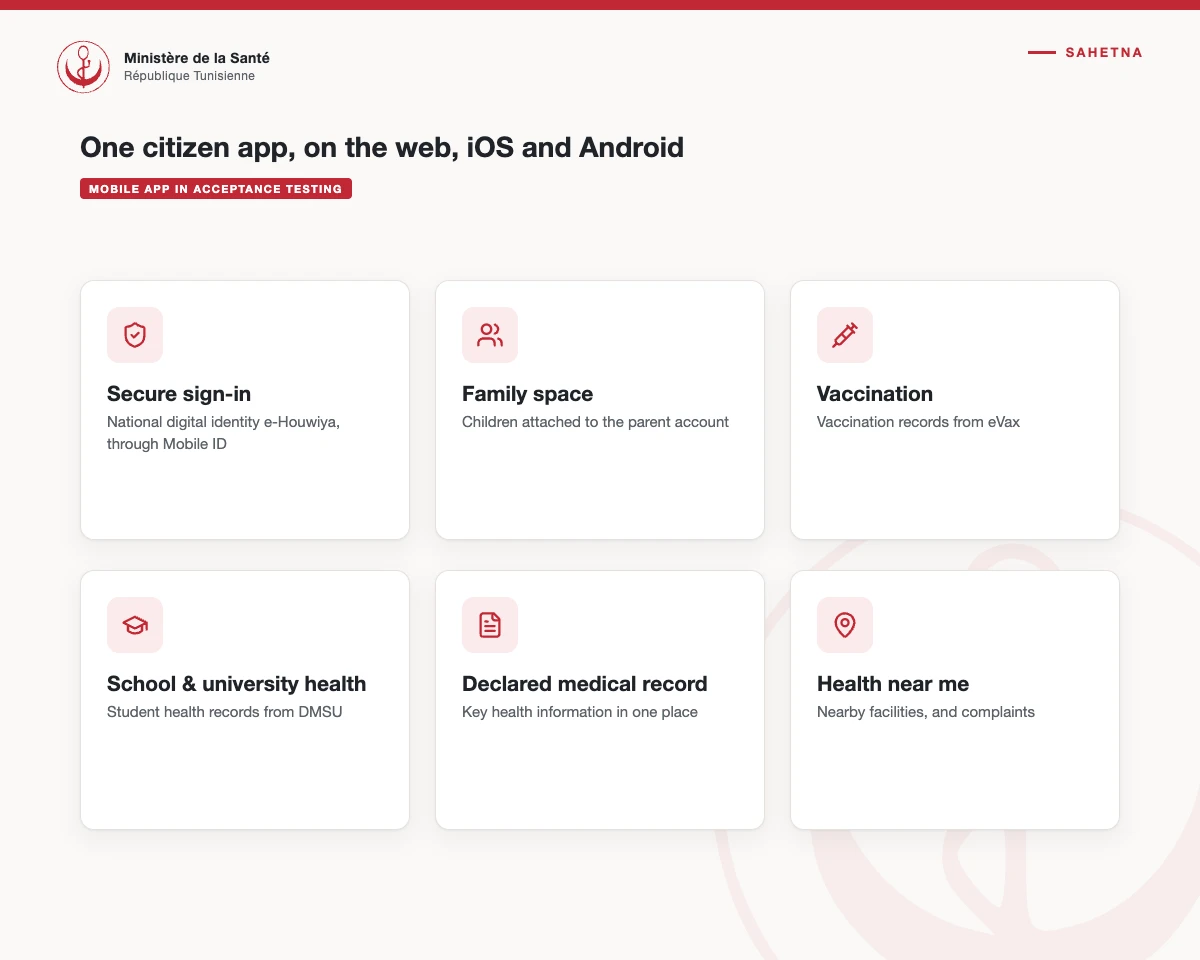
Sahetna brings the national health ID to every citizen: one account for the whole family, connected to the national services. The mobile app, built in React Native for iOS and Android, is in acceptance testing.

  • Sign-in with the national digital identity e-Houwiya, through Mobile ID
  • Children attached to the parent account
  • Vaccination records and school and university health
  • Declared medical record, health near me and complaints

Architecture & Interoperability

The foundations that let the ministry add services without starting over
Interoperability built on standards

Interoperability built on standards

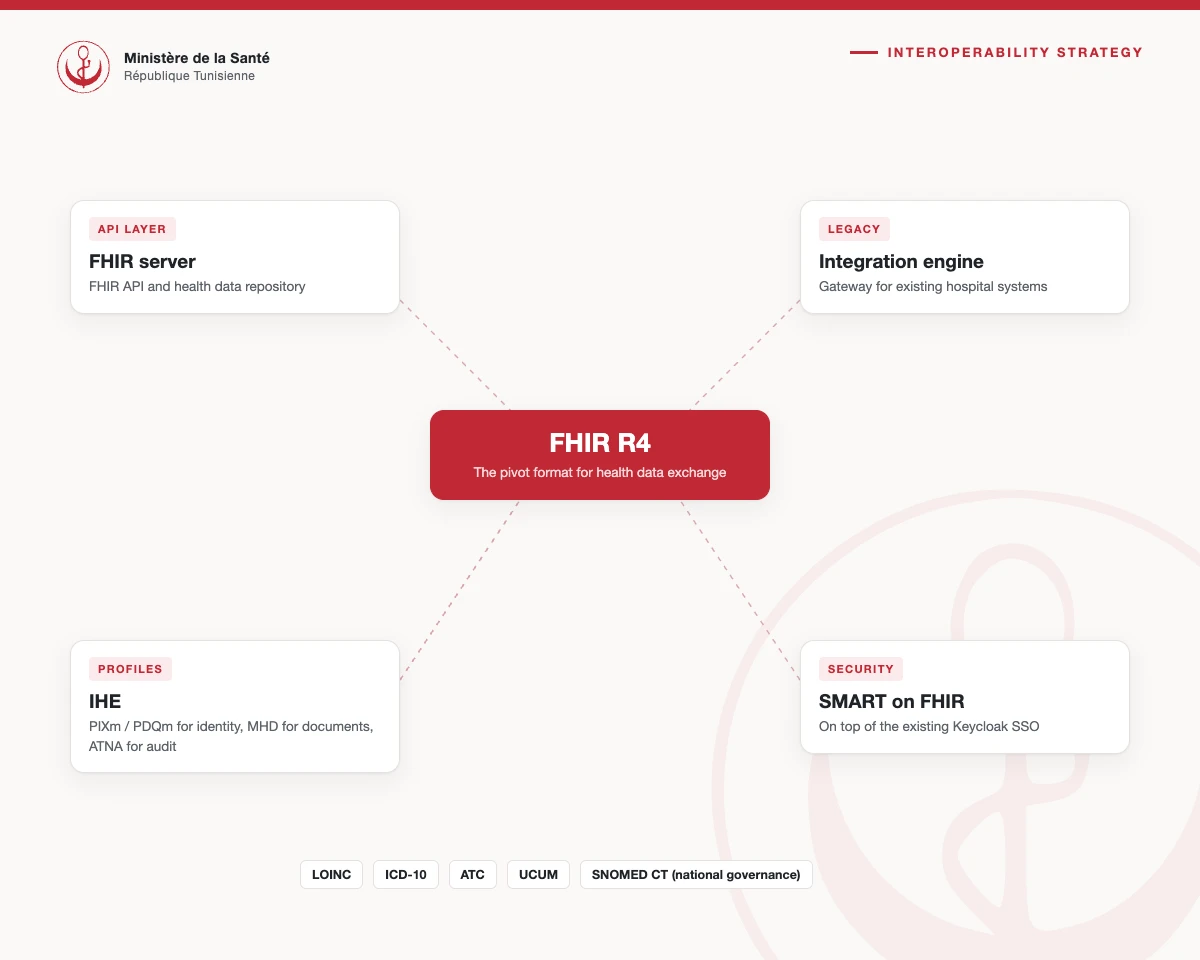
We proposed an interoperability strategy based on international health standards, so that existing and future systems can exchange data without one-off integrations.

  • FHIR R4 as the pivot format
  • IHE profiles for patient identity, documents and audit
  • SMART on FHIR on top of the existing single sign-on
  • International terminologies: LOINC, ICD-10, ATC, UCUM

Key architecture decisions

The principles agreed with the ministry and applied to every platform.

Every platform is hosted in the ministry's own data centre, on a container platform operated with the ministry's teams.

Databases run in high-availability clusters with automatic failover, behind load balancers and the ministry's web application firewall.

A single sign-on platform serves citizens and health professionals in separate spaces, and connects to the national digital identity.

Applications follow OWASP guidelines and go through independent security audits, with findings tracked and fixed before go-live.

Architecture documents, procedure manuals and training sessions on the architecture and the technology stack let the ministry's IT centre run and extend the platforms.

« Au-delà de vos compétences techniques, qui sont remarquables, vous avez fait honneur à l'image de Satoripop et de l'ESN tunisienne capable de relever le défi. »

« Votre image auprès du ministère, la Banque mondiale et l'UNOPS est très valorisée. Fier de vous avoir comme partenaire privilégié. »

Beyond your technical skills, which are remarkable, you have done credit to Satoripop and to the Tunisian IT services industry, which proved it can rise to the challenge. Your reputation with the ministry, the World Bank and UNOPS is highly valued. Proud to have you as a preferred partner.
Partner, EY Consulting Tunisia

The Impact

The building blocks of a national digital health system are in place

A shared architecture

Every platform of the ministry now aligns with one target architecture, validated by the ministry and its IT centre.

One identity for each citizen

A national health ID, generated from birth and shared through secured APIs, with single sign-on in production.

A ministry that owns its systems

Health professionals and the ministry's technical teams trained to use, run and extend the platforms.

Modernizing a public information system?

Tell us about your institutions, your systems and your partners. We will help you design the architecture and build the platforms on top of it. Talk to our team