




























Banks and insurers in Tunisia and the region now ask us about AI assistants for their customers, agents that read documents and models trained on their own data. In those conversations with their leaders, the AI Act has not come up yet.
It already applies to any bank or insurer whose AI serves customers in Europe, even from outside the EU: since 2 August 2026, an assistant that talks to customers must tell them they are talking to an AI. On 2 December 2027, credit scoring and life and health insurance pricing become high-risk, with logs, human oversight and an impact assessment to show. Six decisions follow, in this order: put the chief executive in charge, classify your AI uses, settle where they run, write down which data may leave the building, prepare the teams who will work with them, and decide what you build and what you buy. Hardware, training and, for models built in-house, the provider's obligations take the longest, which is why they cannot wait for 2027.
The AI Act already applies, even outside the EU
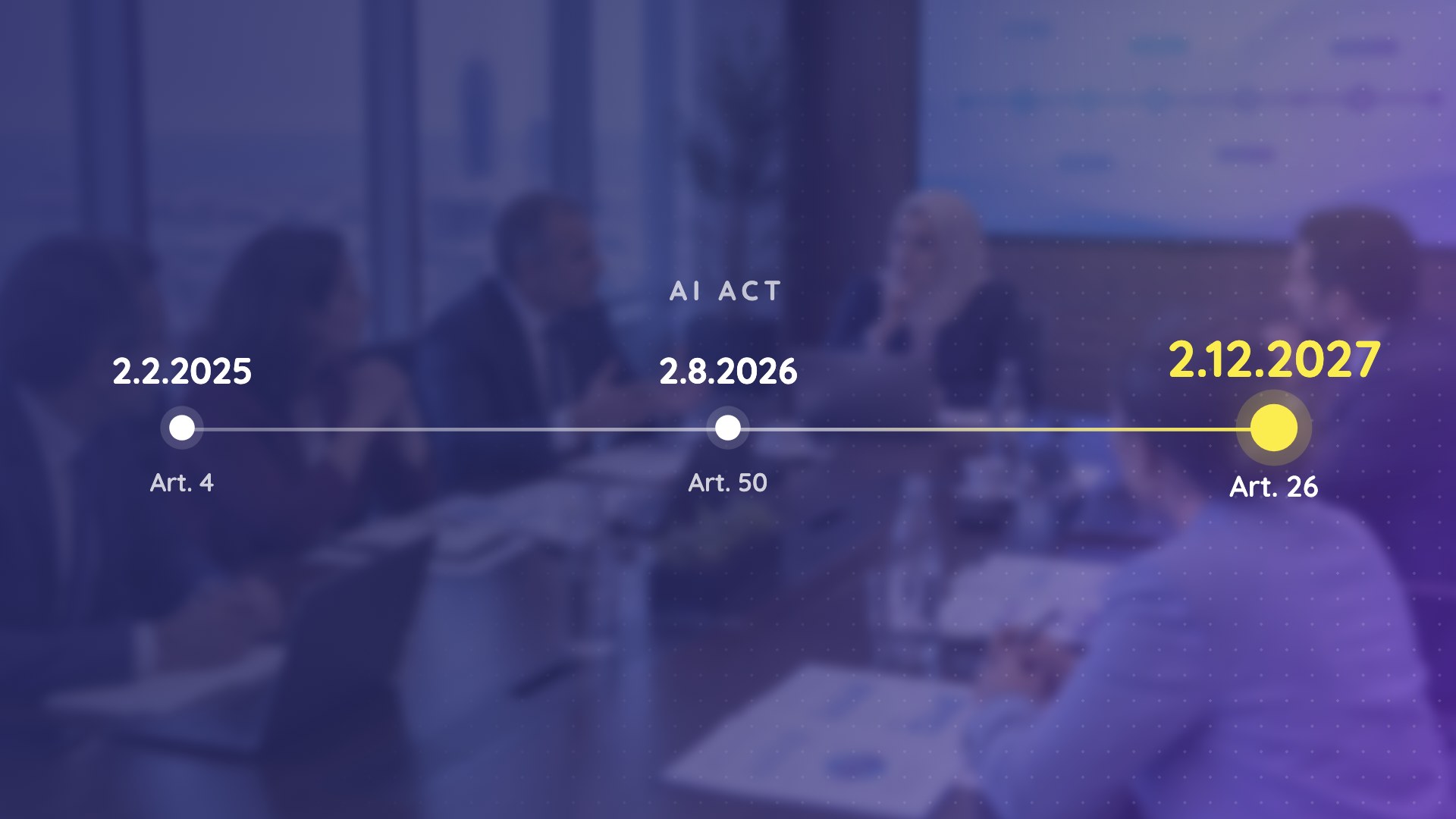
The AI Act (Regulation (EU) 2024/1689) applies in stages, and the Digital Omnibus on AI, Regulation (EU) 2026/1744, in force since 27 July 2026, moved only some of them:
| Since or from | What applies | What it touches in a bank or an insurer |
|---|---|---|
| 2 February 2025 | AI literacy: providers and deployers take measures to support the AI skills of the staff who use AI systems (Article 4, as softened by the Omnibus) | Every department using AI |
| 2 August 2026 | Transparency: an AI system that interacts directly with people must be designed so they know they are talking to an AI, unless it is obvious (Article 50(1)) | Customer assistants on the web, the app and messaging |
| 2 December 2027 | High-risk rules of Annex III, including deployers' duties and the fundamental-rights impact assessment (Articles 26 and 27). A fixed date set by the Omnibus; it was 2 August 2026 | Credit scoring of individuals; risk assessment and pricing in life and health insurance |
Breaching the transparency or deployer obligations can cost up to EUR 15 million or 3% of worldwide annual turnover, whichever is higher (Article 99(4)); SMEs and small mid-caps pay the lower of the two.
The text reaches beyond Europe. Article 2(1)(c) covers providers and deployers established in a third country "where the output produced by the AI system is used in the Union". A Tunisian bank with customers living in Europe, as STB Bank has, can bring the assistant those customers use within that scope. The 2027 date gives time for scoring and pricing; it gives none for an assistant already in production.
For an institution outside the EU, Khaireddine Fredj sees compliance as a framework worth adopting whether or not the text binds it:
The AI Act should be seen less as an obligation than as best practices that protect everyone involved. — Khaireddine Fredj, CEO, Satoripop
Those involved are the customers whose data and decisions are at stake, the staff who answer for what the AI produces, the institution facing its supervisor, and the vendors who build the systems.
Decision 1: the chief executive leads, through a cross-functional committee
AI Act compliance is a cross-functional project, so it needs a steering committee led by the chief executive and a multidisciplinary team behind it. The decisions that follow cut across every department: classifying uses involves the business lines and risk, hosting and hardware involve IT and finance, the data rule involves compliance and the data protection officer, and training involves HR and the managers of the teams who will oversee the models. No single function can decide a hardware budget or a build-or-buy choice for the whole institution.
Decision 2: which of your AI uses are high-risk, and what that costs
List every AI use, pilots included, and classify each one first: the obligations depend on the use. Annex III, point 5, names two uses in financial services:
- Credit: systems that evaluate the creditworthiness of individuals or establish their credit score. Systems used to detect financial fraud are excluded.
- Life and health insurance: systems used for risk assessment and pricing of individuals.
Customer service assistants, document agents reading claim files and internal assistants for advisors are not on that list, and neither is non-life pricing (auto, home, travel). They carry transparency and AI literacy duties, so they can keep the pace the business chooses.
For a high-risk use, the institution that deploys it must, from December 2027:
- use it according to the provider's instructions and assign human oversight to people with the competence, training, authority and support it requires (Article 26(1) and (2));
- keep the logs the system generates for at least six months (Article 26(6));
- tell the people concerned that a high-risk AI system is used in decisions about them (Article 26(11));
- carry out a fundamental-rights impact assessment before first use, which can reuse the GDPR data protection impact assessment (Article 27, as amended by the Omnibus).
The authority that will check is one the institution already knows: for high-risk AI in financial institutions, the market surveillance authority is the national financial supervisor (Article 74(6)). How these duties shape an AI system, from document grounding to audit logs, is covered on our page on AI agents for banks and insurers.
Decision 3: where your AI runs, and the hardware to secure now
The AI Act does not require AI to run on premises. Where it runs is a business decision, and it sets the budget, the timeline and how much of the data and logs the institution controls directly. At STB Bank, everything runs inside the bank: an open-source model fine-tuned on premises with the bank's own data, and the agent tooling around it, in the bank's data center. The bank's IT department pushed for that choice, and it is the one we recommend whenever an institution has the physical means to host the models.
Those means are the bottleneck. Asked what a chief executive should decide first, Khaireddine puts hardware at the top:
Plan your hardware capacity now: the market is very tight. — Khaireddine Fredj, CEO, Satoripop
TrendForce expects server memory to remain undersupplied in the fourth quarter of 2026, with conventional DRAM contract prices up another 10 to 15% over the quarter, after much steeper rises in the first half of the year. A server budget approved in 2026 does not buy what it would have bought in 2025.
Size it on measurements, not on estimates. Before telling STB how many conversations the platform will handle, we run a load test on real scenarios, on the machine the bank provides. We do it on every AI deployment, because the volume a board approves should come from a test on its own hardware, not from a vendor's slide.
Decision 4: which data may leave the building
An institution that cannot host its models has two tools: anonymization and a hybrid architecture. Data that identifies a customer or reveals an account, a claim or a health condition stays on infrastructure the institution controls. Anonymized data, and tasks that need no customer data at all, can use external compute. Pseudonymized data does not qualify: under the GDPR (recital 26) it remains personal data.
We apply the same rule to ourselves. Khaireddine is based in San Francisco, and we work directly with inference platforms such as Fireworks AI, which give us speed and flexibility on models and capacity. Sensitive data never goes through their servers, even though Fireworks does not use customer inputs to train its models without explicit opt-in. A provider's policy can change or fail; data that never left your infrastructure cannot leak from someone else's.
Write the rule once, at executive level: which data categories never leave, which may leave once anonymized, and which projects may use external capacity. Every AI project then starts from it instead of renegotiating it with each vendor.
Decision 5: prepare the business teams, not only IT
Khaireddine's second priority is people: business teams need to change their mindset and learn to work augmented by AI. In his view, that takes soft skills and the humanities as much as technical training.
The regulation leads to the same place. Article 4 has required since February 2025 that providers and deployers take measures to support the AI literacy of the staff who use AI on their behalf; the Omnibus removed any required level of skill but kept the duty. From December 2027, the people who oversee a credit scoring or life and health pricing system must have the competence, training and authority to do it (Article 26(2)). They are the credit analysts and underwriters who review what the models produce, and they are the people to train first.
Decision 6: what you build and what you buy
Whether the institution builds or buys a high-risk system decides which obligations it carries. A bank that develops its own credit scoring model and puts it into service is its provider, not only its deployer. Article 16 then requires, among other things, a quality management system, technical documentation, a conformity assessment before use, an EU declaration of conformity and registration. That is a programme of its own, and the strongest reason to start the build-or-buy decision for scoring and pricing models now.
When you buy, Article 50(1) and the high-risk requirements fall first on the vendor, and the institution's job is to check before signing. The questions we would ask in your place, of any vendor, us included:
- Is this use high-risk under Annex III, and who will be the provider: you or us?
- How does the assistant tell a customer they are talking to an AI, on every channel?
- Where does the model run, and which data leaves our infrastructure? Show us the flow.
- What does the system log, for how long, and can our auditors read it?
- What did your load test measure, on which scenarios and on which hardware?
What to do on Monday morning
- Set up the steering committee, chaired by the chief executive, with business lines, risk, compliance, IT, finance and HR.
- List every AI use, in production and in pilot, and mark those that touch credit scoring or life and health pricing.
- Check which assistants answer customers living in Europe, and whether they say they are an AI.
- For each scoring or pricing model, record if you are its provider or only its deployer.
- Write the data rule: what never leaves, what leaves anonymized.
- Put hardware in the 2027 budget, sized after a load test on your own scenarios.
- Plan the training of the teams who will oversee the models alongside the first project.
We take leadership teams through these decisions in a scoping workshop: your AI uses listed, classified against the AI Act, and the order in which to decide. Ask us for one, or read how we built the on-premises AI platform for STB Bank.