
























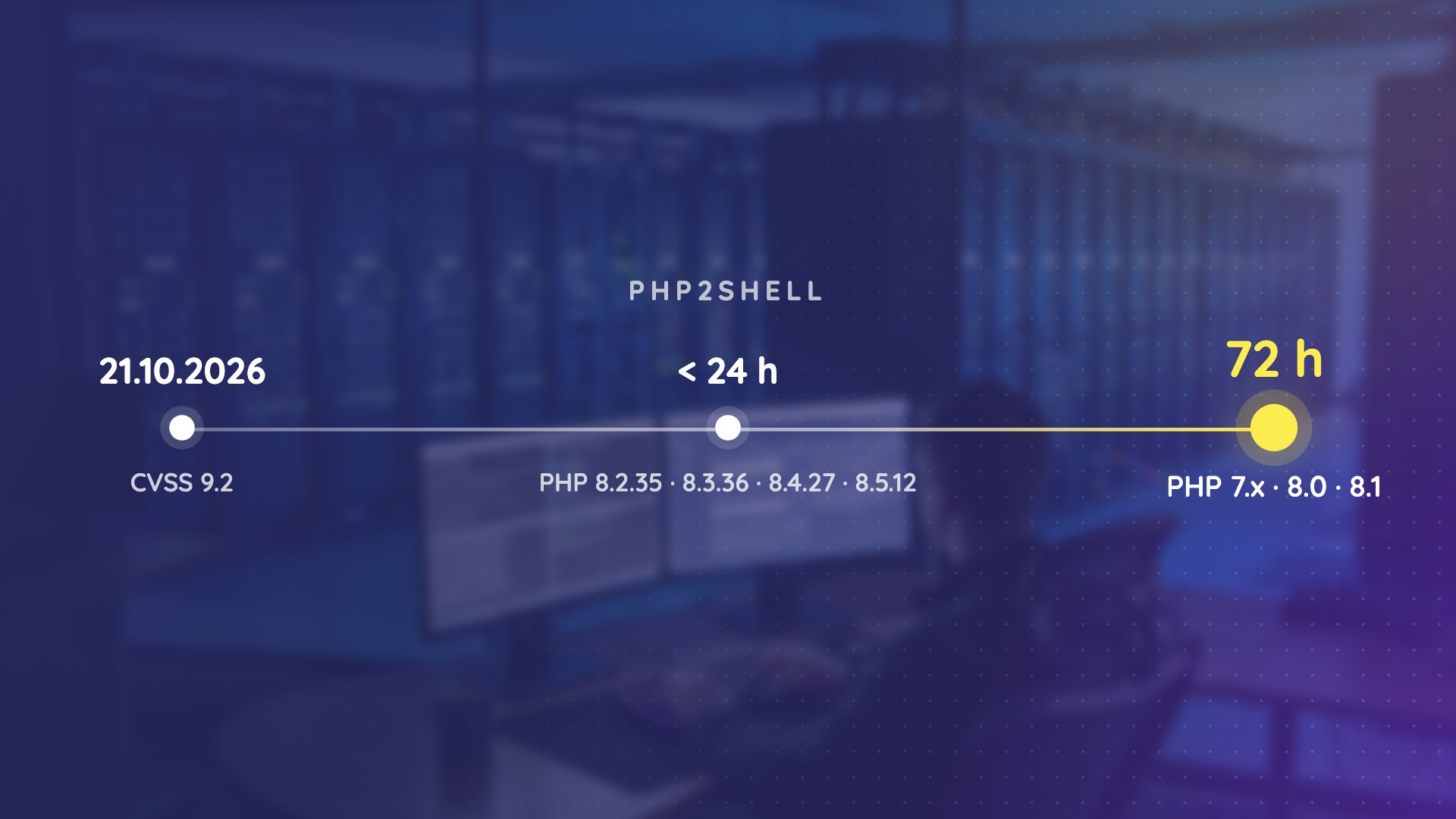
On 21 October 2026, the PHP project shipped emergency fixes for PHP2Shell, two flaws that let an unauthenticated request run code on the server. They were rated CVSS v4.0 9.2, and Cloudflare was already seeing attacks the same day. Within 24 hours, around a hundred machines across our clients' projects (VMs, containers and Kubernetes workloads) were patched and verified. Within 72 hours, the last projects stuck on PHP versions with no official fix were covered too.
Two moves made that possible. The infrastructure team patched every server it already knew that same evening, while the maintenance teams built an inventory to find everything else. Every fix then went through the same checks before anyone called it done: the version actually served, the logs, and the application's critical journeys. This is the order we followed, day by day, and what we changed afterwards.
21 October, evening: patch what you know, inventory the rest
Our security watch picked up the release on 21 October. That evening, the infrastructure team moved the servers it manages directly to the fixed releases, starting with PHP 8.2.35. It did not wait for a complete inventory, because those servers were already known: version, configuration, exposure.
The rest of the estate was less visible: projects run by the maintenance (TMA) teams, container images, PHP installed from several sources. At 23:11, our service manager asked every maintenance team for one table, due at 10:00 the next morning, with one row per project and environment:
| Column | What we asked for |
|---|---|
| PHP version | The exact version served, read from the running site, not from the documentation |
| Execution mode | PHP-FPM, Apache mod_php or CGI, and whether it runs in a container |
| Package source | The distribution, a third-party repository such as Remi, a container image or a custom build |
| Exposure | Public on the internet or internal only |
| Target | 8.2.35, 8.3.36, 8.4.27 or 8.5.12, the four fixed releases |
| Flag | PHP 7.x, 8.0 and 8.1, which the PHP project no longer updates, set aside for a joint decision with the client |
The package source column decides who ships the fix. Canonical's fix for Ubuntu 20.04 and older came only through Ubuntu Pro, for example. Our older Ubuntu servers were not waiting on it: PHP on those machines came from another repository or an image, so the fix came from there.
The night of 21 to 22 October: the order of the work
We ordered the work with four criteria, in this sequence:
- Public exposure. A site reachable from the internet goes before an internal tool.
- Execution mode. The PHP project considered "the risk highest for mod_php", where an unauthenticated request could trigger the attack before any application code ran.
- Sensitive data. Banking, insurance, personal and payment data.
- Business criticality. Online stores, and the service levels in each maintenance contract.
At 03:31, a client was already asking for a status. At 06:25, the answer went out: upgrade done, no trace of exploitation in the logs. Each client heard from its own project manager, who relayed the status from the infrastructure and maintenance teams, so the client had one contact throughout.
By the end of 22 October, every maintenance team had returned its table, and the projects it surfaced were patched in the same order.
22 October: a fix counts once it is served, clean and tested
After each update, three checks closed the ticket.
The version actually served. We read it in one of three ways, depending on the setup: an HTTP request to the site itself, the status of the FPM pool or of the module Apache had loaded, or php -v inside the running container. Each worker was restarted first, since workers already in memory keep the old code.
The logs. We looked for traces of exploitation in four places: web access logs; PHP-FPM and error logs, for crashed workers and memory errors; processes started by the web user and recent files in web directories and /tmp; and Microsoft Defender or EDR alerts on the machines that have them. Nothing turned up.
The critical journeys. The development teams ran smoke tests on each project: login, cart, payment, back office. They found a few regressions where a dependency or application code was incompatible with the new PHP version, and fixed them before closing. Without that step, those regressions would have reached users as a second incident.
The same day brought a second critical flaw. GitLab's critical patch release of 21 October fixed CVE-2026-110264, rated CVSS 10.0, unauthenticated code execution on self-managed instances. We updated our own instance and those we host for clients. They run GitLab's official packages, which carry the fix (a patch to Ruby), so it was a routine update. An installation with its own Ruby runtime would also have needed a Ruby upgrade.
23 and 24 October: the versions with no fix
Two to five projects ran PHP 7.x, 8.0 or 8.1. For these, there was no release to install. With each client, we chose between a backported fix, temporary measures and a migration.
On 23 October, a client on PHP 8.0 received a fix backported by a package maintainer, as a transition. Its migration to a supported version remains planned: a backport covers this flaw, and the next one may get none. Alongside the backports, the legacy projects ran behind two temporary measures: the php.ini mitigation published by the PHP project, and network filtering or WAF rules.
That same day, the PHP project disclosed another flaw, CVE-2026-115560, with no fix yet. Its mitigation was to set session.upload_progress.enabled=0 until the next bugfix release. We applied it across the whole estate. The PHP project warned against relying on ini_set() or FPM .user.ini for it, so the setting went into the server configuration, followed by a restart of the workers.
By the 72-hour mark, every legacy project had its backport or its temporary measures in place, and the development teams had started the PHP and application upgrades that will take them off unsupported versions.
2 November: a false alarm, and what it changed
On 2 November, Microsoft Defender for Cloud raised a High alert on a client VM: "Possible Web Server compromise activity". The client's CISO asked for an urgent analysis. The logs settled it, with timestamps to the second: one of our maintenance scripts, run from /tmp under the web server's user. To Defender, that pattern looks like a web shell.
We changed our intervention procedure:
- Maintenance scripts live in a dedicated, versioned directory, never in
/tmp. - They run under a dedicated maintenance account, never under the web server's user.
- The client is told before any manual intervention on its servers.
- Every intervention is logged with its author, its action and its time, so the next alert can be matched against the log directly.
What the 72 hours told our clients
The inventory showed every client what it actually runs. For some, that included a stack out of support, such as a Magento 2.3.5 store. A backport or a mitigation covers one flaw at a time; only a migration removes the dependence on the next one. For those stacks, the crisis turned into migration proposals.
For a CIO whose applications are run by an internal team or a provider, three questions test readiness before the next critical flaw:
- Can the team produce, within hours, the version served, the execution mode, the package source and the exposure of every environment?
- Is the priority rule written down, and who applies it at night?
- For each unsupported stack, is the answer to "no fix available" already agreed: backport, temporary measures or migration?
The checklist to keep ready
- Keep the inventory table current, one row per project and environment.
- Patch the known servers at once; use the inventory to find the rest.
- Restart the workers and read the version served from the site, the FPM or Apache status, or inside the container.
- Search web, PHP and error logs, processes, recent files and security alerts for traces of exploitation.
- Have the development teams test the critical journeys of every project before closing.
- Apply published mitigations to the whole estate, in the server configuration.
- For containers, put every fix into the image, so the next build does not undo it.
- Keep one contact per client for status updates.
- Run maintenance from a dedicated account and directory, and log every intervention.
This is the work behind our security, backup and incident management service, run with our application maintenance teams. For the stacks that should not depend on the next backport, see our approach to legacy and platform modernization.